Writing the same content five times for five platforms is the fastest way to lose 20 hours a month as a creator. Posting on one platform only is the slowest path to growth. Almost every solo founder running content-led distribution sits between those two failure modes, paying the time cost of duplication or the reach cost of single-platform discipline.
The cross-posting workflow that closes the gap is operational, not theoretical. The X thread gets written first, the LinkedIn variant adapts to long-form, Bluesky condenses to 300 graphemes, Threads loosens into casual cadence, and Mastodon respects federation norms with platform-native phrasing. Done natively, the math comes out around 60 minutes per multi-platform post. Done inside Typefully, the same workflow compresses to 15-20 minutes. The 45-minute delta compounds: at 4-5 multi-platform posts per week, it adds up to 18-20 hours saved every month.
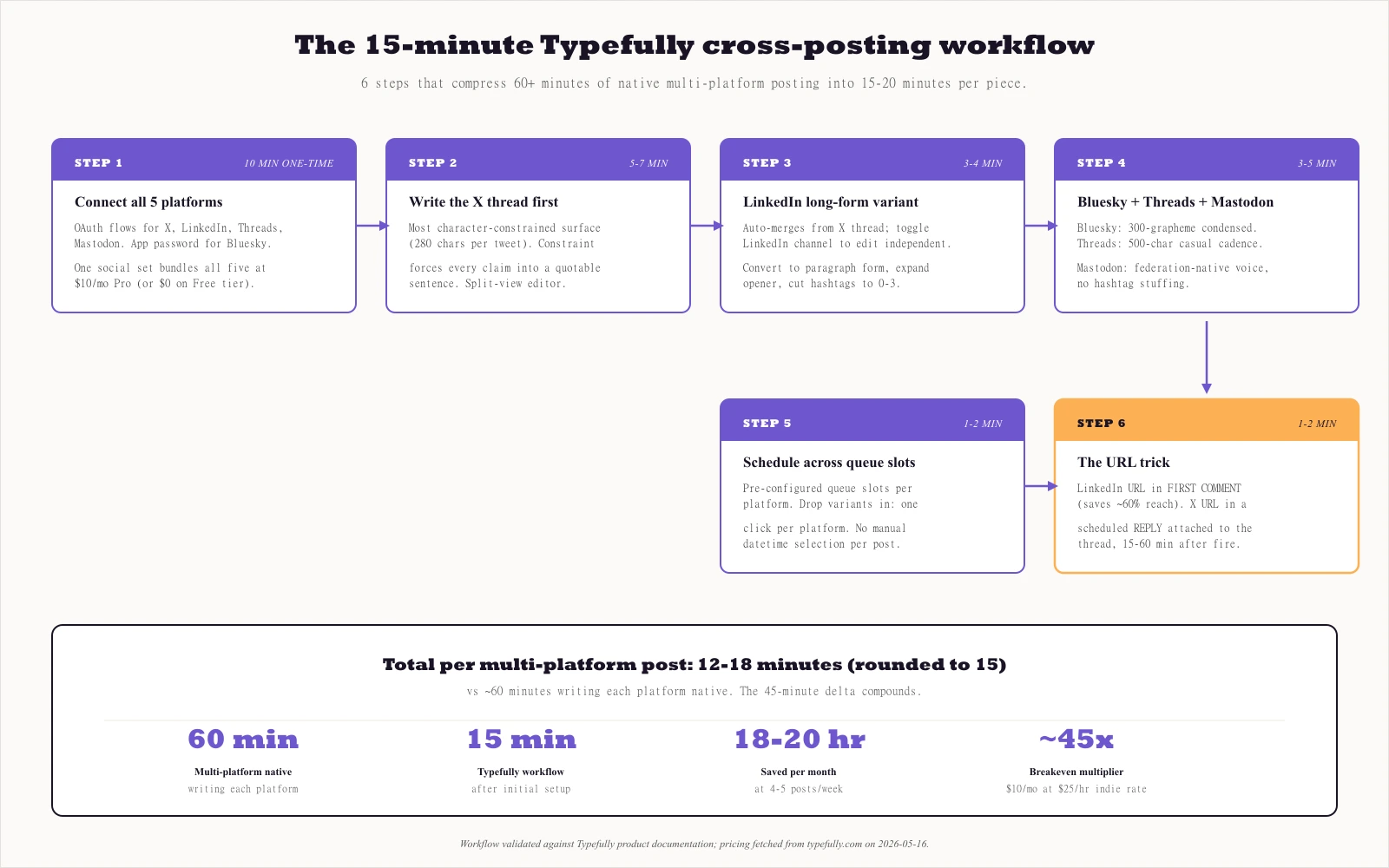
The 15-minute Typefully workflow at a glance
For thread-first creators posting 3+ multi-platform posts per week, Typefully’s cross-platform workflow compresses 60 minutes of native posting into 15-20 minutes per piece across X, LinkedIn, Bluesky, Threads, and Mastodon. The mechanic is X-first composition (most character-constrained surface), then per-platform variants generated or adapted in the same composer. One social set at $10/mo bundles all five platforms.
The 6-step workflow: connect all five platforms once (10 min one-time), write the X thread first (5-7 min), adapt the LinkedIn long-form variant (3-4 min), condense Bluesky/Threads/Mastodon variants (3-5 min), schedule across queue slots (1-2 min), and add the URL workarounds (scheduled X reply, LinkedIn first comment, 1-2 min). After initial setup, total per-post: 12-18 minutes rounded to 15.
The math: at a conservative $25/hour indie rate, Typefully Pro at $10/month earns its subscription back in ~24 minutes of saved drafting per month. At typical creator cadence (4-5 multi-platform posts/week), the workflow saves 18-20 hours/month, which earns the $10 back roughly 45-50x against time alone.
Try Typefully free → Free at $0/mo covers 15 posts/month with full engagement features.
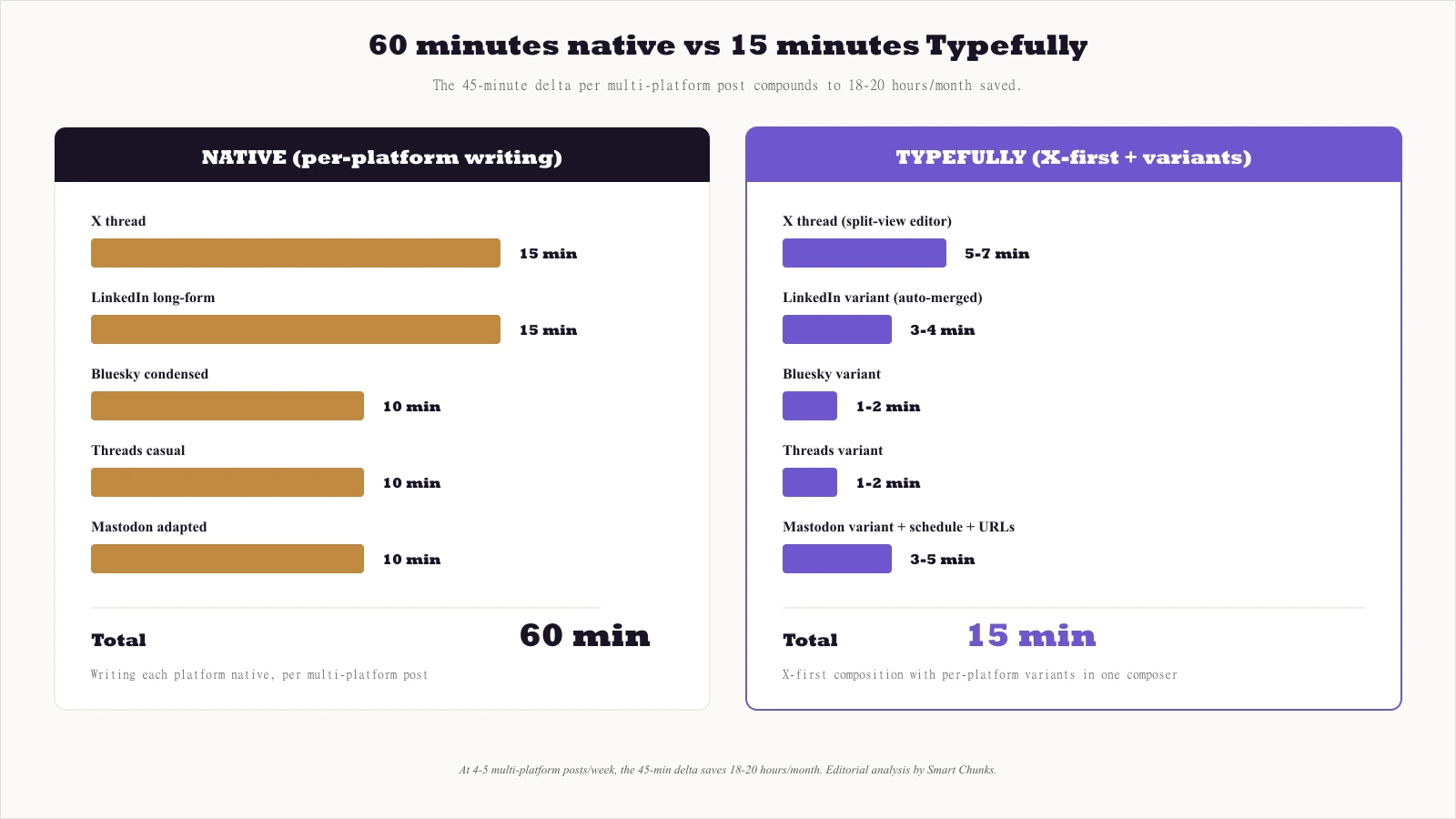
Multi-platform native posting vs Typefully cross-posting time math, in minutes per piece.
Writing X + LinkedIn + Bluesky + Threads + Mastodon native takes ~60 minutes per piece (15 min X thread + 15 min LinkedIn long-form + 10 min Bluesky condensed + 10 min Threads + 10 min Mastodon). Typefully compresses this to 15-20 minutes by writing the X version first and adapting per platform. The 45-minute delta compounds at 4-5 multi-platform posts/week into 18-20 hours saved per month.
If this workflow assumes Typefully is the right scheduler for your profile, that decision sits one layer back. For the full pricing analysis, weakness audit, and decision framework, see our Typefully Pro review and $10/mo verdict. For the broader category comparison against Hypefury and Buffer, see our Typefully vs Hypefury vs Buffer 2026 verdict. Both articles map reader profiles to tool fit. This one assumes the fit is established and walks through the operational workflow.
Step 1: Connect all five platforms (one-time, ~10 minutes)
The setup phase happens once. Subsequent posts skip directly to step 2.
10 min one-time setup
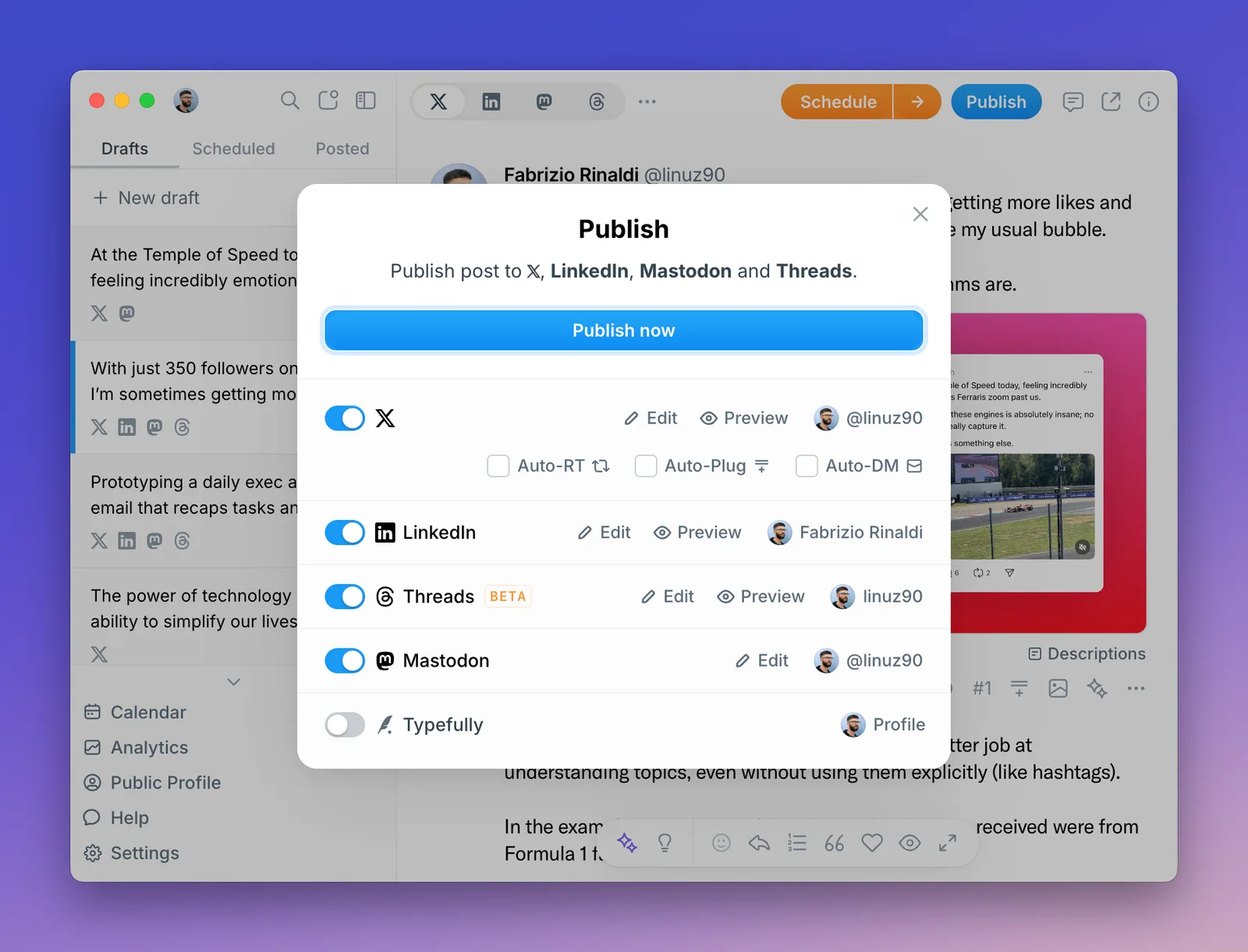
Connect X, LinkedIn, Bluesky, Threads, and Mastodon to one Typefully social set
Open Typefully and click Settings → Connected accounts. Each platform connects via OAuth in 1-3 minutes:
- X (Twitter): OAuth via X Developer flow. Required permissions: read, write, post threads.
- LinkedIn: OAuth via LinkedIn’s API. Personal profile and Company Page both supported.
- Bluesky: App password via the Bluesky settings page (not your account password). Use Bluesky’s official “Create app password” flow at bsky.app/settings/app-passwords.
- Threads: OAuth via Meta’s Threads API. Requires an Instagram-linked Threads account.
- Mastodon: Enter your instance URL (e.g., mastodon.social) and authorize via the instance’s standard OAuth flow.
Once connected, all five platforms appear as channel toggles in the upper-left of the composer. Toggling a platform on includes it in the next scheduled post; toggling off excludes it.
A practical caveat on Bluesky: the App Password flow is separate from your main Bluesky password. Generate it specifically for Typefully and label it accordingly so revocation is clean if you ever rotate access.
On Threads: the connection requires an Instagram account because Threads is architecturally a Meta product. Solo creators without Instagram cannot connect Threads to Typefully, which is a real (and largely unavoidable) gotcha.
On Mastodon: instance choice matters more than account name. A creator on mastodon.social gets different reach behavior than one on a niche-topic instance like indieweb.social. Connect the instance where your audience already follows you, not a fresh account.
Step 2: Write the X thread first (5-7 minutes)
The single most important workflow decision is what you write first. The answer is always X.
5-7 min
Compose the X thread in Typefully’s split-view editor
Open a new draft. The composer’s left pane is for raw text; the right pane renders the thread preview. Each tweet gets its own 280-character counter. Drag handles let you reorder tweets without rewriting.
Why X-first works:
- X has the tightest character constraint (280 per tweet). Writing for the constraint first forces every claim into a quotable sentence.
- LinkedIn long-form expands easily from a tight X thread. Going the other direction (LinkedIn-first, then trim for X) routinely loses the hook.
- Bluesky’s 300-grapheme limit is close enough to X’s 280 that the X version often works as-is on Bluesky with minor edits.
- Threads and Mastodon both accept 500-character posts, which gives room to expand from the tight X version rather than further compress from LinkedIn.
Use Typefully’s pre-publish character validation to catch the silent-truncation failure mode: a tweet at 281 characters fails on X with no warning in the native composer, but Typefully’s editor flags it visibly before publish.
The architectural truth about thread writing is that constraint drives quality. A 5-tweet thread where every tweet stands alone as a quotable claim outperforms a 5-tweet thread written as one continuous paragraph chopped at 280-character boundaries. The constraint forces you to find the load-bearing sentence inside each beat.
“The X thread that earns the click is the one where any single tweet, pulled out of context, still says something specific enough to be quoted.”
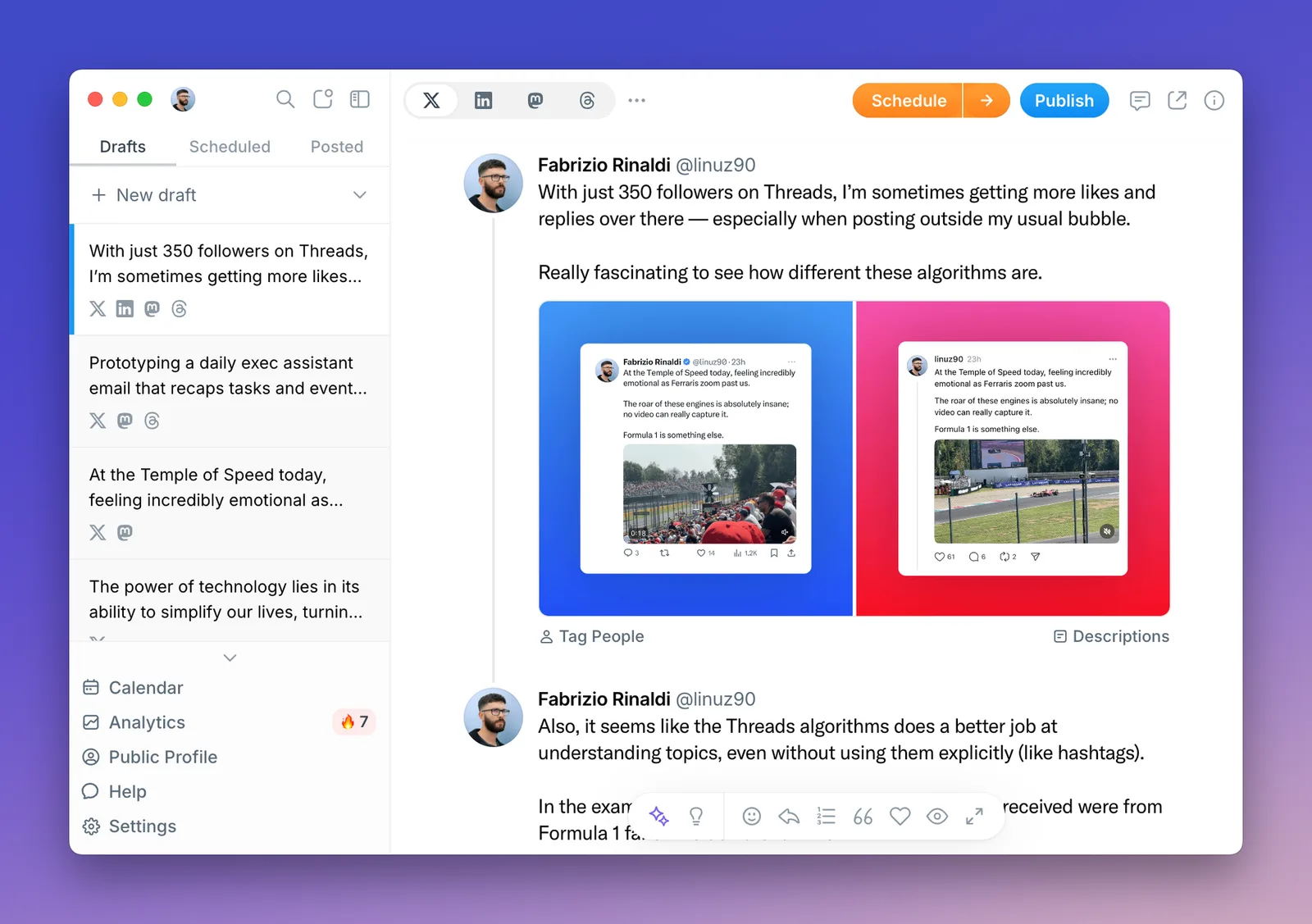
If you have Typefully Pro, the AI Writing Assistant (powered by Claude) can suggest tighter hook variants or condense a wordy tweet to fit 280 characters. Treat it as a senior writing collaborator, not a junior writer. Feed it your draft and let it suggest sharper rewrites, but never let it write from scratch on a topic you haven't thought through.
Step 3: The LinkedIn variant (3-4 minutes)
LinkedIn is a different beast. Different audience, different format, different algorithmic rules.
3-4 min
Adapt the X thread into a single LinkedIn long-form post
Toggle LinkedIn on in the channel selector. By default, Typefully auto-merges the X thread into a single unified LinkedIn post. That’s useful for content coherence, but the merged version usually reads as “this was clearly written for Twitter first” if shipped without edits.
To customize independently, click the LinkedIn channel toggle in the upper-left of the composer to enter LinkedIn-specific editing mode. The edits don’t alter the X version. Per Typefully’s documentation: “Click the LinkedIn toggle to edit your LinkedIn post independently without altering drafts for other platforms.”
What the LinkedIn variant should change vs the X thread:
- Convert from numbered-tweet structure to paragraph form. LinkedIn rewards prose, not threads.
- Expand the strongest claim into a 2-3 sentence opener. LinkedIn’s algorithm shows the first ~3 lines before “see more”; those lines decide the click.
- Add one specific scenario or example absent from the X version. LinkedIn readers want concrete proof, not pithy claims.
- Cut hashtags. LinkedIn’s hashtag-stuffing penalty is real; 0-3 hashtags max, placed at the end.
- Save the external URL for the FIRST COMMENT, not the post body. (See “the URL trick” section below.)
The LinkedIn variant should read as if you wrote it for LinkedIn, even though you wrote the X thread first. The "this was clearly cross-posted from Twitter" tell drops engagement noticeably. Two minutes of restructuring is the difference between a post that compounds on LinkedIn and one that gets buried.
Step 4: Bluesky, Threads, and Mastodon variants (3-5 minutes total)
The condensed-format platforms get the fastest variant work. Most of the X-first thread translates with minor edits.
3-5 min
Generate Bluesky, Threads, and Mastodon variants from the X thread
Toggle each platform on in turn and edit per Typefully’s per-platform character counter:
- Bluesky (300 graphemes). The first tweet of your X thread often works as a standalone Bluesky post with a minor tightening pass. Bluesky audiences expect direct, declarative posts rather than long threads. Reuse the strongest standalone claim from your X thread; cut the rest.
- Threads (500 characters). Threads readers expect more casual cadence, closer to a quick observation than a polished essay. Combine two of your X thread’s tweets into a single 400-450 character Threads post. Drop the most formal phrasing.
- Mastodon (500 characters, instance-dependent). Federation norms matter. Identical content cross-posted to Mastodon without adaptation gets flagged as auto-spam and reduces reach. Re-write the first 2 lines of your X thread in a more contextual, instance-aware voice. Avoid hashtag stuffing.
The federation-respect issue with Mastodon deserves its own line. Mastodon's culture is anti-corporate-marketing by default, and the community signals that to algorithm-adjacent ranking. A Mastodon post that reads as "this was clearly auto-cross-posted from Twitter" gets less engagement and more "please don't bot-post here" replies. The fix isn't to skip Mastodon. It's to give Mastodon 90 seconds of native voice.
A workable pattern: take the X thread's most generous claim (the one that gives something to the reader rather than asking for attention), rephrase it in plainer language, and post it as a standalone Mastodon update. Federation rewards generosity.
Step 5: Schedule across queue slots (1-2 minutes)
Typefully's scheduling architecture is queue-based, not datetime-based. The distinction saves real time.
1-2 min
Drop variants into pre-configured queue slots per platform
Pro tier supports up to 1000 scheduled posts/month, calendar view, and per-platform queue slots. Configure once: Settings → Queue slots.
Example slot configuration for a thread-first creator:
- X: 9am EST Monday, Wednesday, Friday (peak engagement windows)
- LinkedIn: 7am EST Tuesday, Thursday (commute-time professional reading)
- Bluesky: 10am EST Monday, Wednesday, Friday (15-min stagger after X)
- Threads: 11am EST Monday, Wednesday, Friday (later casual scroll window)
- Mastodon: 12pm EST Monday, Wednesday, Friday (instance-time variable)
With slots set, dropping a multi-platform draft into the queue takes one click per platform: each variant auto-fills into the next available slot for its platform. No manual datetime entry per post.
The architectural advantage of queue slots over datetime scheduling: a multi-platform post takes one click per variant instead of five separate "select date, select time" entries. For a creator publishing 4-5 multi-platform posts per week, that's 20-25 manual datetime selections per week saved, roughly 5-10 minutes weekly or two-thirty hours a year.
A second advantage: queue slots enforce consistent publishing cadence without requiring conscious scheduling discipline. A creator who configures "X publishes at 9am EST Mon/Wed/Fri" and queues 3 drafts each week ships consistently because the calendar enforces the cadence.
Step 6: The URL trick (1-2 minutes)
This step is where most cross-posting tutorials stop short and where conversion math actually lives. External URLs in post bodies tank reach on both X and LinkedIn. The workaround is operational, not theoretical.
1-2 min
Add URL replies on X and first-comment URLs on LinkedIn
Both X and LinkedIn algorithmically suppress reach on posts containing external URLs in the main body. LinkedIn cuts ~60% of reach. X applies a similar but less-documented suppression layer.
For X: the main thread contains zero URLs. The article link, lead magnet, or call-to-action lives in a scheduled REPLY attached to the thread. Typefully supports reply scheduling natively. Write the reply, attach it to the thread parent, and schedule it 15-60 minutes after the thread fire.
For LinkedIn: the post body contains zero URLs. The link lives in the FIRST COMMENT, which Typefully schedules separately. The First Comment feature is included on all Typefully tiers, including Free.
To configure: in the composer, with the LinkedIn channel toggled on, find the “First Comment” field below the main post. Add the URL there with whatever context line you’d normally include in the post body.
Reach reduction when LinkedIn posts contain external URLs in the body.
LinkedIn’s algorithm explicitly demotes posts with external links to keep users in-platform. The first-comment workaround preserves reach while keeping the link accessible. Typefully’s First Comment scheduling automates the workaround on every tier including Free. The same logic applies to X: main thread URL-free, URL in a scheduled reply.
The URL trick is the largest single conversion lever in any cross-platform workflow. A creator who masters steps 1-5 but skips step 6 leaves 50%+ of social reach on the table, which is a lot of money for an indie operator depending on traffic for affiliate revenue, newsletter signups, or product purchases.
Start the workflow on Typefully free →
Bulk scheduling: the weekly batch workflow
The 15-minute per-post workflow scales to a weekly batch in 60-75 minutes. Five multi-platform posts × five platforms = 25 scheduled items, prepared in a single batch session.
The batch flow:
- Block 60-75 minutes on Sunday or Monday morning. Less is doable with experience; more is wasteful.
- Write five X threads back-to-back in Typefully's editor. Switch the composer to a "blank draft" → finish → blank draft cycle. Don't context-switch to other tasks between drafts. 25-35 minutes total.
- Generate LinkedIn variants for all five in one focused pass. The mental shift from "X-thread tone" to "LinkedIn long-form tone" only costs 1-2 minutes; switching contexts five times costs 10+ minutes.
- Knock out Bluesky, Threads, and Mastodon variants in a single 15-minute sweep. By this point in the batch, you've internalized each platform's voice and the variants generate fast.
- Schedule all 25 variants into queue slots. Five clicks per post; 25 total. 5-10 minutes.
The batch architecture is faster than per-post workflow not because Typefully is doing anything different, but because context-switching is the hidden cost in most cross-platform workflows. A creator who batches once per week spends ~70 minutes total on cross-platform writing and gets a full week of posts queued. A creator who writes one piece per day spends the same total time but adds 5-10 minutes of context-switching daily.
For higher-volume creators or agencies, Typefully Pro supports CSV bulk-import for drafts: prepare a week or month of posts in a spreadsheet, upload, and edit per-variant in the dashboard. The pattern compounds at 10+ posts/week.
When to use AI rewrites (and when to skip)
Typefully's AI Writing Assistant ships on Pro and above. The underlying model is Claude, which produces fewer "AI tone tells" than the previous generation of writing tools. The workflow integration is inline: highlight a draft in the editor, click Rewrite & Improve, and Typefully returns 2-3 variant rewrites.
Where the AI actually helps in a cross-posting workflow:
- Rewriting a flat hook into three sharper variants. The AI's pattern-match on viral-thread structure produces decent rewrite candidates worth picking from.
- Condensing a wordy tweet to fit 280 characters. Mechanical compression that humans tend to over-think.
- Generating LinkedIn long-form from a published X thread. The "expand from constraint" direction works; "compress from sprawl" works less well.
- Bulk alt-text generation for accessibility-compliant image descriptions across all five platforms.
Where the AI doesn't help, and using it costs more than it saves:
- Writing posts from scratch on un-researched topics. Output reads generic and AI-detected.
- Generating viral hooks without seed input. The AI needs a draft to work from; "give me a viral hook about AI agents" produces vapor.
- Replacing editorial judgment on what to publish. The AI suggests; you decide.
- Producing long-form analysis without source material. Hallucination risk too high to ship.
The practical rule for cross-posting: use the AI for the mechanical compression and expansion passes between platform variants. Don't use it to generate content from scratch. The 15-minute workflow assumes you bring an idea worth publishing; the AI just makes the per-platform adaptation faster.
Analytics: what to actually look at
Typefully's analytics dashboard ships X-first. For a multi-platform workflow, that's a real gap worth naming so you set realistic expectations.
Typefully's X Analytics (Pro tier and above):
- Detailed Metrics: engagement rate, impressions, profile clicks
- Profile Conversion Rate: percentage of profile visitors who follow
- Tweeting Streaks: consecutive-days posting streaks
- CSV export: for offline analysis
What's notably absent: first-class analytics for LinkedIn, Bluesky, Threads, and Mastodon. Independent reviewers have flagged this as Typefully's main weakness for LinkedIn-specific creators. The dashboard doesn't surface LinkedIn engagement rate, top-performing carousels, or audience growth on LinkedIn the way it surfaces those metrics for X.
For a cross-platform workflow specifically, the workaround is to lean on each platform's native analytics:
| Platform | Where to check analytics | What to measure |
|---|---|---|
| X | Typefully X Analytics dashboard | Engagement rate, profile conversion rate, top tweets |
| LinkedIn native dashboard or Shield.app ($15-30/mo) | Engagement rate, top carousels, audience growth | |
| Bluesky | Bluesky native analytics (limited) or third-party tools | Repost rate, audience growth |
| Threads | Threads native insights (Meta-integrated) | Reach, engagement, follower growth |
| Mastodon | Instance-native or third-party Mastodon analytics | Boost rate, instance-relative reach |
The product calculus is consistent across this batch: Typefully optimizes for X-first creators with cross-platform distribution, not for analytics-first creators measuring multi-platform performance. If your weekly review cadence is "look at X analytics + skim LinkedIn analytics natively," the workflow fits. If you need a unified dashboard, the gap is large enough to warrant a separate analytics tool.
Common mistakes (and how to skip them)
The mistakes worth naming aren't beginner errors. They're the operational details experienced creators still get wrong, costing reach on every post.
Mistake 1: Identical content across all 5 platforms
Fix: Per-platform variants. Use Typefully’s channel toggles to edit each variant independently. Identical cross-posts get flagged by both LinkedIn’s algorithm and Mastodon’s community norms.
Mistake 2: External URL in LinkedIn post body
Fix: Move URL to FIRST COMMENT via Typefully’s First Comment scheduling. Available on every tier including Free. LinkedIn cuts ~60% of reach on bodies containing external links.
Mistake 3: External URL in X main thread
Fix: Move URL to a scheduled REPLY attached to the thread. Typefully supports reply scheduling natively. Keep the main thread URL-free; the reply carries the link.
Mistake 4: Mastodon variant reads as auto-spam
Fix: Re-write the Mastodon variant in federation-native tone. No hashtag stuffing, context-aware phrasing, instance-appropriate length. 90 seconds of native voice is the difference between reach and rejection.
Mistake 5: Scheduling all 5 platforms at the same minute
Fix: Stagger publish times by 15-60 minutes per platform to match each platform’s peak engagement window. Typefully’s queue slots make staggering a one-time configuration.
Mistake 6: Skipping the pre-publish character check
Fix: Typefully’s split-view editor surfaces character overflows before publish. The native X composer does NOT warn about thread breakage; a tweet at 281 characters silently truncates.
The mistakes compound. A creator who fixes mistake 2 alone (LinkedIn first-comment) typically sees a 40-60% lift in LinkedIn reach within two weeks. Fixing 2 + 3 + 5 together (URL workarounds plus staggered scheduling) often doubles cross-platform engagement. The math is asymmetric: each fix is a 1-minute behavior change with multi-week compounding reach impact.
When this tutorial isn't right for you
Three reader profiles where the Typefully cross-posting workflow is the wrong fit. Each is specific. Recognize yourself in any of them and a different tool earns the buy.
Wrong fit 1: Instagram, TikTok, or YouTube is your primary platform. Typefully ships zero support for those three. The 5-platform cluster is deliberately federation-friendly and text-first. For creators whose strategy depends on Instagram Reels, TikTok shorts, or YouTube Shorts, Hypefury at $29-$199/month covers Instagram and Tweet-to-Reels conversion alongside the same X + LinkedIn + Bluesky + Threads + Mastodon cluster. The video-repurposing automation is the real differentiator for X-primary creators converting top tweets into vertical video.
Wrong fit 2: you're an X-only occasional poster under 15 posts/month. Typefully Free at $0/month already covers this. The Pro upgrade trigger is hitting the 15-posts/month cap or wanting AI features and X Analytics. For 1-2 threads/week on X only with no cross-posting, the cross-platform workflow is overkill — write directly in X or use Free for scheduling alone.
Wrong fit 3: your strategy depends on 8+ platforms (Pinterest, Facebook, Google Business Profile, etc.). Typefully's 5-platform cluster is comprehensive within the text-first federation slice but doesn't cover breadth. Buffer at $6/channel/month covers 11 platforms including Pinterest and Google Business Profile. If your weekly publishing footprint spans those platforms, the breadth wins over Typefully's depth.
For creators outside these wrong-fit profiles (thread-first, posting 3+ times/week, across 3+ platforms in the federation cluster), the workflow is the strongest pick in 2026.
Decision framework: does this workflow fit your profile?
Five questions. Each maps to a yes/no answer that determines fit.
- Do you post 3+ multi-platform pieces per week? Yes → the workflow’s time savings compound at this cadence. No → Free tier or single-platform native composers cover lower volume without paying.
- Are at least 3 of your platforms in the X + LinkedIn + Bluesky + Threads + Mastodon cluster? Yes → Typefully covers the cluster as one bundled social set. No → a different tool fits your platform mix better.
- Are you willing to write the X version first? Yes → the X-first architecture is the workflow’s load-bearing decision. No → the workflow loses its quality compounding; LinkedIn-first inversions routinely lose hooks.
- Do you want per-platform variants rather than identical cross-posts? Yes → Typefully’s channel toggles make per-platform editing fast. No → the workflow saves no time over single-platform-and-copy-paste.
- Do you need video-repurposing automation (Tweet-to-Reels, YouTube Shorts)? No → Typefully fits. Yes → Hypefury Creator at $65/month is the right pick for video-first workflows.
A 3+ thread-first creator working across the federation cluster, willing to write X-first with per-platform variants, lands squarely on the workflow. Questions 1-4 are the load-bearing dimensions. Question 5 is the exclusion gate for video-first creators.
Bottom line: who this workflow is for
Three reader profiles fit the workflow cleanly:
- Thread-first creator posting 3+ multi-platform pieces per week across X + LinkedIn + Bluesky + Threads + Mastodon. The primary fit; 18-20 hours/month saved at typical cadence.
- Multi-brand creator or small agency running 2-4 client brands across the same cluster. Pro × N social sets stays cheaper than Buffer per-channel × N brands.
- Solo founder running content-led distribution who treats threads as the primary content unit and wants federation-friendly platform coverage. No Instagram/TikTok dependency.
For these profiles, the 15-minute Typefully workflow is the strongest cross-platform scheduling pattern in 2026. The breakeven math compounds: $10/month earns back in 24 minutes of saved drafting; the actual savings at typical cadence run 18-20 hours/month.
Ready to run the 15-minute workflow on your own content?
For thread-first creators posting across X, LinkedIn, Bluesky, Threads, and Mastodon, Typefully Pro at $10/month per social set compresses 60+ minutes of native multi-platform writing into 15-20 minutes per piece.
Split-view thread editor + AI Writing Assistant + per-platform variants + queue scheduling + First Comment automation + URL-reply workflow, all bundled in one social set. Free tier covers 15 posts/month with full engagement features for evaluation before paying.
No credit card required for the Free plan. 15 posts/month + Auto-DMs + Schedule Retweets + First Comment included. Pro upgrade at $10/month per social set ($8/month billed yearly = $96/year) adds AI writing, X Analytics, Calendar, and 1000 posts/month.
For the deeper single-tool analysis (pricing breakdown, weakness audit, Free-to-Pro upgrade triggers), see our Typefully Pro review and $10/mo verdict. For the category-level comparison against Hypefury (engagement automation) and Buffer (cross-platform breadth), see our Typefully vs Hypefury vs Buffer 2026 verdict.
Frequently asked questions
Can I auto-post the same content to all 5 platforms without editing per platform?
Technically yes — toggle all 5 platforms on, write once, schedule. Practically, this is the largest unforced error in cross-platform workflows. Identical content across X + LinkedIn + Bluesky + Threads + Mastodon gets flagged by LinkedIn's algorithm (reach cut), reads as auto-spam on Mastodon (community norm violation), and underperforms on Threads (different format expectations). The 90-second per-platform edit captures 30-50% more engagement on every variant. The math works out to ~10 minutes of platform-adaptation work per multi-platform post, returning hours of compounded reach.
What happens if Typefully fails to post on one platform?
Typefully retries automatically and surfaces the failure in the dashboard for manual intervention. Successful platforms publish normally; failed platforms get queued for retry. Most failures are recoverable (LinkedIn API rate-limited briefly, Mastodon instance offline). Critical failures (your X account is suspended, LinkedIn revoked API access) surface as connection errors in Settings → Connected accounts and require re-authorization. The architecture is fail-soft per platform rather than fail-hard across the whole post.
Does X suppress posts with external links the same way LinkedIn does?
Less documented than LinkedIn's ~60% reach cut, but algorithmically similar. Posts with external URLs in the main body get reduced reach compared to URL-free posts. The workaround is the same operational pattern: keep the main thread URL-free, post the URL in a scheduled REPLY attached to the thread. Typefully supports reply scheduling natively, which makes the workaround a one-click addition during step 6 of the workflow. The reply-URL pattern preserves reach on the main thread while keeping the link accessible to readers who care to click through.
Can I schedule replies to my own threads on X using Typefully?
Yes. Reply scheduling is a first-class feature: write the reply, attach it to the parent thread, and configure the delay (typically 15-60 minutes post-thread-fire). Use this for the URL-reply workaround on X, for engagement automation (replying to your own thread with a follow-up insight), or for thread continuation across multiple days. Reply scheduling works on Free and Pro tiers; Business adds collaborative reply approval workflows.
Does Typefully support Threads and Bluesky for free or only on Pro?
Both platforms are supported on every tier including Free at $0/month. The 5-platform cluster (X + LinkedIn + Bluesky + Threads + Mastodon) is bundled into the single social set on every tier. The Free tier caps at 15 posts/month across the cluster, which works for occasional creators; per-platform variants count as separate scheduled posts, so a creator posting 1 thread/week with 5-platform variants uses 5 posts × 4.3 weeks ≈ 21-22 posts/month, exceeding Free. For multi-platform cadence at 3+ pieces/week, Pro tier at $10/month is the working tier. If you're still on Typefully Free and weighing whether the Pro upgrade is worth $10/month, our Pro tier review breaks down the breakeven math and reader profiles so you know exactly when the upgrade earns its keep. To start the workflow on the Free tier, sign up via this link.
Disclosure: this article includes affiliate links to Typefully and Hypefury. Smart Chunks may earn a commission if you sign up via these links at no extra cost to you. Recommendations are based on our editorial analysis of pricing, features, and platform documentation as fetched on May 19, 2026, with Typefully pricing confirmed via direct vendor screenshots within the 7-day freshness window. Buffer is included as a comparison reference only and is not an affiliate of Smart Chunks. See our editorial standards for the full methodology.