Three frontier AI models sit at exactly 57 on the Artificial Analysis Intelligence Index as of April 18, 2026. Claude Opus 4.7, Gemini 3.1 Pro Preview, and GPT-5.4 (xhigh) each pull the same integer. Claude Opus 4.6 lags at 53. Those four-point gaps are now quoted in vendor pitches, earnings slides, and industry roundups as if they carry the precision of a lab measurement.
They don't.
The composite is real, the methodology is public, and the confidence interval is tight enough that the number does mean something. But "intelligence" is doing a lot of work inside that one number. The 57 on Opus 4.7 is not the same 57 you get on Gemini 3.1 Pro. They are two different model profiles that happen to sum to the same weighted total.
Here is what the index actually measures, how to read a one-point gap, and what the composite cannot tell you.
| Rank | Model | Provider | Index | Reasoning tier | Input / output (per 1M tokens) | Cost to run full index |
|---|---|---|---|---|---|---|
| 1 (tie) | Claude Opus 4.7 | Anthropic | 57 | Adaptive Reasoning, Max Effort | $5 / $25 | $4,406.45 |
| 1 (tie) | Gemini 3.1 Pro Preview | Google DeepMind | 57 | Default (preview) | $2 / $12 | $892.28 |
| 1 (tie) | GPT-5.4 | OpenAI | 57 | xhigh reasoning | $2.50 / $15 | Not published on model page |
| 4 | GPT-5.3 Codex | OpenAI | 54 | xhigh reasoning | N/A | N/A |
| 5 | Claude Opus 4.6 | Anthropic | 53 | Adaptive Reasoning, Max Effort | $5 / $25 | $1,451.04 |
| 6 | GLM-5.1 | Open weights (Zhipu / Tsinghua) | 51 | Reasoning | Open weights | N/A |
| 7 | GLM-5 | Open weights (Zhipu / Tsinghua) | 50 | Reasoning | Open weights | N/A |
| 8 | MiniMax-M2.7 | MiniMax | 50 | N/A | N/A | N/A |
How the index is calculated
Artificial Analysis, an independent model-evaluations firm, runs a composite called the Intelligence Index. The current version is v4.0, patched to v4.0.4 as of the March 2026 methodology update. Version 4.0 went live on January 6, 2026, replacing the older saturated index that had capped out at 73 for the top model.
The composite is a weighted average across four equal-weight categories at 25% each.
Agents (25%). GDPval-AA at 16.7% and τ²-Bench Telecom at 8.3%. GDPval-AA is AA's own run of OpenAI's GDPval dataset, which tests models on 220 real deliverables (spreadsheets, documents, diagrams, multimedia) authored by industry professionals with an average of 14 years of experience across 44 occupations and nine GDP sectors. Scoring is ELO, not pass@1, via blind pairwise comparisons anchored to GPT-5.1 Non-Reasoning at 1,000 ELO. τ²-Bench Telecom tests agentic behavior in a simulated customer-support environment.
Coding (25%). Terminal-Bench Hard at 16.7% and SciCode at 8.3%. Terminal-Bench Hard tests agents operating in a real shell. SciCode pairs scientific reasoning with code across 288 subproblems drawn from 80 laboratory problems in 16 disciplines.
General (25%). AA-LCR (long-context reasoning) at 6.25%, AA-Omniscience at 12.5%, and IFBench (instruction following, 58 verifiable constraints) at 6.25%. AA-Omniscience uniquely penalizes hallucinations: it rewards accuracy and punishes confident wrong answers, with the two sub-scores contributing 6.25% each.
Scientific Reasoning (25%). Humanity's Last Exam at 12.5%, GPQA Diamond at 6.25%, and CritPt at 6.25%. HLE draws 2,500 expert-vetted questions designed to resist retrieval. GPQA Diamond is the 198-question "diamond subset" where PhD experts score 65% and skilled non-experts with web access stall at 34%. CritPt is new and deliberately brutal: 71 unpublished, research-level physics problems built by 50+ physicists across 11 subfields. Best base-model average accuracy sits at 4%, and even the best reasoning model currently tops out near 30%.
The weighted composite is calibrated to give frontier models room at the top. When v4.0 launched, the lead model scored around 50 on the new scale, down from 73 on v3.0. Three months later, Opus 4.7, GPT-5.4 xhigh, and Gemini 3.1 Pro have run the ceiling back up to 57.
A quick word on the two things the index is not. First, it is not SWE-bench. AA removed SWE-bench from the index before v4.0, along with MMLU-Pro, AIME 2025, and LiveCodeBench, because the frontier models were saturating them. If you see a commentary pointing to SWE-bench scores to defend a current Intelligence Index number, the commentary is out of date. Second, it is not a decimal. Every public AA surface (the main leaderboard, the individual model pages, and the head-to-head comparison pages) publishes the Intelligence Index as an integer. "Opus 4.7 scored 57.18 to Gemini's 57.17" is a number someone made up to break a tie that, on the public Index, does not have decimals to break. AA estimates a 95% confidence interval of less than ±1% on the composite, and also notes that individual components have wider confidence bands. Within the aggregate uncertainty, 57-vs-57 is statistically a tie.
What a one-point gap actually buys you
Claude Opus 4.6 at 53. The three models above it at 57. That is a four-point delta on a 100-point scale, or roughly 7% relative.
It is also the size of one Opus minor-version jump. Opus 4.6 was Anthropic's flagship Claude release before Opus 4.7 landed on April 16, 2026, and the same lab moved the same index score from 53 to 57 inside that version bump. That is how far a frontier lab can push a mature model family inside one minor iteration without changing the underlying architecture or context window.
So "a four-point Index gap" is better framed as "the work a frontier lab does in the interval between its own point releases," not "the gap between adult and child." One point, then, is a modest post-training refinement at the frontier. That is measurable, that is real, and that is also a lot less than the phrase "Intelligence Index" conjures.
The ±1% confidence band matters here. Two models separated by one integer point on v4.0 are not reliably distinguishable outside of noise on most individual runs. AA's own methodology makes that explicit. When three models hit 57 on the nose, they are not "racing to the finish in a photo finish." They are sitting comfortably inside the same confidence interval, and the 57 is a consensus position the index hands back rather than a photo of the actual hierarchy underneath.
What the 57 is hiding
The component-level numbers break the illusion fast.
On GDPval-AA, the single biggest-weighted evaluation in the composite at 16.7%, Opus 4.7 leads at 1,753 ELO. GPT-5.4 (xhigh) follows at 1,674 ELO. Gemini 3.1 Pro Preview is fourth in that public ranking at 1,314 ELO, behind Claude Sonnet 4.6 at 1,672. That is a 439-point ELO gap between two models that share the same composite. In chess terms, 439 ELO is a ceiling on roughly a 92% expected win rate. Translated to AA's blind pairwise comparisons: on real-deliverable tasks, professional graders prefer Opus 4.7's output over Gemini 3.1 Pro's at a rate that would read as lopsided, not tied, if you were only looking at this benchmark.
Flip the panel to Humanity's Last Exam, weighted 12.5% of the composite. Gemini 3.1 Pro Preview leads at 44.7%. GPT-5.4 (xhigh) posts 41.6%. Opus 4.7's HLE score is not listed in the public top three on AA's HLE leaderboard; whatever the lab's own harness produced, AA's independent run does not rank it ahead of Gemini or GPT-5.4 here.
Same reversal on GPQA Diamond (6.25%). Gemini 3.1 Pro Preview sits at 94.1%, GPT-5.4 (xhigh) at 92.0%. On SciCode (8.3%), Gemini 3.1 Pro Preview leads at 58.9%, GPT-5.4 (xhigh) at 56.6%. On CritPt (6.25%), the tiered OpenAI product, GPT-5.4 Pro (a different-tier variant) leads at 30.0%, Gemini 3 Deep Think at 25.7%, GPT-5.4 (xhigh) at 23.4%.
Stitch the panels back together and the picture is this. Gemini 3.1 Pro wins the classic research-style benchmarks (GPQA Diamond, HLE, SciCode) and trades blows with GPT-5.4 on scientific reasoning. Opus 4.7 wins the Agents category by a landslide on GDPval-AA, the one benchmark that most closely resembles real knowledge-work deliverables. GPT-5.4 is balanced across both, which is how it ends up with the same 57 without leading any single component I could confirm across AA's public leaderboards.
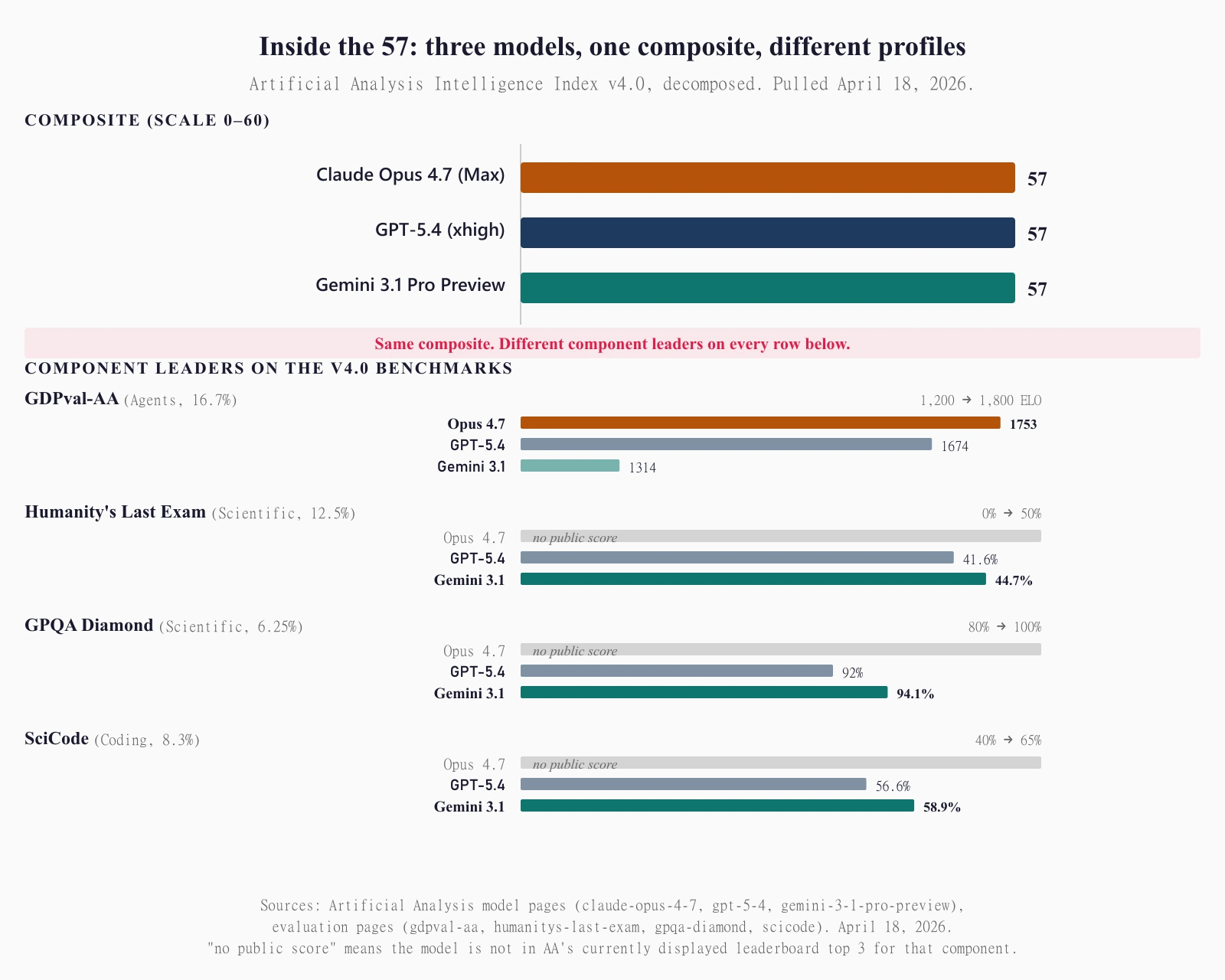
If you are a buyer deciding between these three, the composite is the last thing you should care about. The category sub-scores inside it are the actual signal.
What the index misses
Four things the Intelligence Index v4.0 does not tell you, in descending order of how much it should change your decision.
The confidence interval eats the margin at the top. AA publishes the composite with a sub-±1% CI and also notes that component-level CIs are wider. When three models land on the same integer, the index is telling you "these are within noise" more than it is telling you "these three are tied at the top." It would be cleaner if AA published the decimal and the CI side by side on every model page the way pollsters publish a margin of error, but they currently don't.
The index is text-only, English-only, and does not cover vision, audio, or multilingual performance. AA benchmarks those separately. If your stack routes images to Gemini and text to Claude, the Intelligence Index composite tells you almost nothing about the image-routing decision.
The weighting is a judgment call, not a fact of nature. Agents at 25% and Coding at 25% sum to half the composite, which is a deliberate bet by AA that real-work deliverables and software engineering deserve equal footing with the scientific-reasoning and general-knowledge quarters combined. For a research-shop buyer building a chemistry agent, Scientific Reasoning probably deserves 50% of the weight on its own. For a customer-support deployment, it might deserve 5%. Plug in your own weights with the category scores and you get a different ranking.
Composite scores cannot reward the model that is best at one specific thing you actually need. Grok 4.20 0309 (Reasoning) leads IFBench at 82.9%, better than all three of the 57-tied frontier models on instruction following. Grok sits at 49 overall. If strict instruction adherence is what you are buying, the composite is steering you wrong.
The structural limits
There is no organized, published campaign against AA's Intelligence Index the way there are published campaigns against MMLU or HumanEval. The closest thing I could find to a named published critique is Sebastian Raschka's entry in his LLM Architecture Gallery, last updated March 27, 2026. Raschka, who writes the Ahead of AI newsletter and authored one of the standard machine-learning textbooks, lists three structural caveats that bear repeating.
First, the Index is not an architecture-intrinsic metric. "Two models with very similar stacks can still have very different scores due to training data, post-training, and reasoning behavior." So the Intelligence Index will not tell you whether a lab made a smart architectural bet. It tells you what its training recipe and post-training pipeline produced this quarter.
Second, coverage is uneven. Some models lack clean AA scores because the lab has not given AA endpoint access, or because the model is restricted to a consortium. Claude Mythos Preview, Anthropic's red-team-restricted model behind Project Glasswing, does not appear on the public Index at all. The ranking can only tell you about the subset of models AA has been able to evaluate.
Third, benchmark revisions can shift scores over time independent of the underlying model. When AA dropped MMLU-Pro, AIME 2025, and LiveCodeBench in January, every score on the board moved. Not because any of the models got better or worse, but because the yardstick changed. "The total score and profile [is] a snapshot rather than permanent architectural constants," as Raschka puts it.
None of this is a reason to ignore the Index. It is a reason to read it as a snapshot of one methodology's view at one point in time, which is what AA's own documentation says it is.
Stanford's 2026 AI Index, published by the Institute for Human-Centered AI on April 13, 2026, makes the broader case in starker terms. Ray Perrault, who co-directs the steering committee, puts the benchmark-to-reality gap plainly: "We generally lack measures of how well a system (or agent) needs to function in a particular setting. Knowing that a benchmark for legal reasoning has 75 percent accuracy tells us little about how well it would fit in a law practice's activities." Perrault is not critiquing AA specifically, but the quote lands where the AA composite currently lives.
One caveat worth naming because it would surface in any thorough critique: Andrew Ng has a disclosed investment in Artificial Analysis, per The Batch's standard disclosure line. That is not a conflict that compromises AA's methodology, but it is a reason to treat the index as one commercial evaluator's product rather than as a neutral regulator's stamp.
How to actually use the index
Three practical moves if you are trying to use the composite for something other than marketing copy.
Start from the category scores, not the composite. AA publishes per-category breakdowns on the methodology page. If your use case is coding-heavy, weight Coding at 50% and drop the composite ranking entirely.
Cross-reference the component pages. AA maintains per-evaluation leaderboards for GDPval-AA, GPQA Diamond, HLE, SciCode, IFBench, and the others. They often surface leaders that do not make the top three on the composite. Grok 4.20 leads IFBench; Opus 4.7 dominates GDPval-AA; Gemini owns the classic research benchmarks. The composite hides all of this.
Treat any one-point gap as a tie, and any three-point gap as meaningful but narrower than the vendors will pitch it as. The CI band is wide enough that 57 and 57 are in the same bucket, and the gap from 57 down to 54 (where GPT-5.3 Codex sits relative to the top) is real but modest. This is also roughly the difference between Opus 4.6 max (53) and Opus 4.7 max (57), which you can tactically read as "one full minor-version jump from Anthropic."
For additional context on how this leaderboard sits inside the broader April 2026 model landscape: the Gemini 3.1 Pro benchmark breakdown on GPQA, HLE, LMSys, and FrontierMath covers the single-model view of the Index tie from Google's side, and the real ranking of top frontier AI models for April 2026, beyond marketing headlines places all 57-tied and 50-class models against the open-weights tier six points back.
The index is one of the better tools in the field, and it is also not the signal its fans claim it is. Read the components.
Frequently asked questions
What is the Artificial Analysis Intelligence Index?
The Intelligence Index is a composite score run by Artificial Analysis, an independent model-evaluation firm, that combines 10 evaluations across four equal-weighted categories: Agents, Coding, General, and Scientific Reasoning. Each category contributes 25% to the final score. The current version is v4.0, patched as v4.0.4 in March 2026. Artificial Analysis describes the index as a synthesis metric for generalist model intelligence across reasoning, knowledge, mathematics, and programming.
What is the current ranking as of April 2026?
Three models are tied at 57 on the composite: Claude Opus 4.7 (Adaptive Reasoning, Max Effort), Gemini 3.1 Pro Preview, and GPT-5.4 xhigh. GPT-5.3 Codex xhigh sits at 54, Claude Opus 4.6 at 53, GLM-5.1 Reasoning at 51, GLM-5 Reasoning and MiniMax-M2.7 at 50. Kimi K2 Thinking and the broader open-weights tier follow. Claude Mythos Preview is restricted to Anthropic's Project Glasswing consortium and does not appear on the public leaderboard.
Is the Intelligence Index reported as a decimal like 57.17 or 57.18?
No. On every public Artificial Analysis surface (the main leaderboard, individual model pages, and head-to-head comparison pages), the composite is published as an integer. AA estimates a 95% confidence interval of less than ±1% on the composite itself, and notes that individual component evaluations have wider confidence intervals. When secondary coverage quotes decimals on the Index, those decimals are not reproducible against AA's published figures.
What benchmarks make up the composite?
Ten evaluations: GDPval-AA, τ²-Bench Telecom, Terminal-Bench Hard, SciCode, AA-LCR, AA-Omniscience, IFBench, Humanity's Last Exam, GPQA Diamond, and CritPt. When v4.0 launched in January 2026, AA removed MMLU-Pro, AIME 2025, and LiveCodeBench (the three benchmarks most cited in AI company marketing) because frontier models had saturated them. AA also removed SWE-bench from earlier versions. GDPval-AA carries the biggest single weight at 16.7%.
Why are three different models tied at 57 if they have different strengths?
Because the composite sums across 10 weighted evaluations and the models win different components. Opus 4.7 leads GDPval-AA (Agents, 16.7% weight) at 1,753 ELO versus Gemini 3.1 Pro at 1,314 ELO. Gemini 3.1 Pro leads the scientific-reasoning benchmarks (GPQA Diamond 94.1%, Humanity's Last Exam 44.7%) and SciCode (58.9%). GPT-5.4 xhigh trades second place with Gemini on most components. Different profiles, same weighted total. The composite tie masks substantial divergence at the component level, which is why buyers should read category scores, not just the 57.
How much does it cost to run the full Intelligence Index on one model?
Artificial Analysis publishes the cost per model in the evaluation metadata. Running v4.0 on Claude Opus 4.7 cost $4,406.45 in API usage. Running it on Claude Opus 4.6 cost $1,451.04. Running it on Gemini 3.1 Pro Preview cost $892.28. Those costs reflect the token consumption of the 10 evaluations on each model's pricing. Anthropic's Opus family costs roughly five times what Gemini 3.1 Pro costs to hit the same 57.