The honest answer to "should I pay for AI to build a website" is not yes. It is also not no. It is "depends on what you are building, how often, and how much of your week you can stand to lose to friction."
The conditional answer
Free tiers of Claude, ChatGPT, and Gemini are genuinely sufficient for one-off small builds. A single-page portfolio, a niche calculator, a static landing page, a tiny HTML5 game. The build pipeline at zero dollars works, has been documented in case studies, and ships real sites to real URLs. We covered the full free-tier portfolio path in a step-by-step guide to building a portfolio website with free AI models in 2026, and the same logic carries the calculator and game tutorials.
Paid earns its keep along five specific axes: multi-file codebases that need an agent loop (Claude Code), context windows large enough to hold a real project (Gemini Pro's 1M tokens, Claude Pro's full-project mode), extended thinking for harder reasoning passes, daily message ceilings that do not collapse under sustained work, and time pressure where another two hours of free-tier rate-limit waiting is not free at all. The rough-and-ready rule is that anyone shipping more than three websites a year, or one website with iterative ongoing work, recovers the $20 monthly fee in saved hours within the first project.
Free tier and paid tier capabilities compared
The matrix below extends the free-only comparison from the portfolio guide into the paid columns, with every number from the vendor's own pricing page or help center as of late April 2026.
| Capability | Claude Free | Claude Pro $20 | Claude Max $100 / $200 | ChatGPT Free | ChatGPT Plus $20 | Gemini Free | Google AI Plus $7.99 | Google AI Pro $19.99 |
|---|---|---|---|---|---|---|---|---|
| Default model | Sonnet 4.6 | Sonnet 4.6 + Opus 4.6 | Same as Pro, higher caps | GPT-5.3 | GPT-5.3 Instant + GPT-5.4 Thinking | Gemini 3.1 Pro (capped) | Gemini 3.1 Pro + Thinking | Same as Plus, higher caps |
| Daily / window cap | ~10–20 msgs / 5h (community-reported) | ~5x Free / 5h, plus weekly cap since Aug 28, 2025 | 5x or 20x Pro / 5h | 10 msgs / 5h then GPT-5 Mini | ~80 GPT-5.4 Thinking / 3h, 3,000 / week | 30 prompts/day on 3.1 Pro | 100 prompts/day on 3.1 Pro | 500 prompts/day on 3.1 Pro |
| Artifacts / Canvas | Artifacts: yes. No Projects persistence | Artifacts + unlimited Projects | Same as Pro | Canvas: paid-only | Canvas included | Canvas-style output via chat | Canvas-style output via chat | Same as Plus |
| Extended thinking / reasoning | Limited usage | Included | Included with priority | Not on free | GPT-5.4 Thinking, 80 / 3h | Limited Thinking | 90 Thinking / day | 300 Thinking / day |
| Image generation | None native | None native | None native | 2–3 / day on GPT Image 1.5 | ~50 / 3h, ~200 / day | 20 Nano Banana 2 / day | 50 NB2 / day | 100 NB2 / day plus Nano Banana Pro |
| Coding agent | None | Includes Claude Code | Includes Claude Code with priority | Codex base | Codex with Plus quota | Gemini CLI 1,000 req/day | Same as free CLI tier | Gemini CLI 1,500 req/day |
| Context window | 200K tokens | 200K tokens (1M select) | 200K tokens (1M select) | 32K (Instant) | 32K Instant, 256K Thinking | 32K | 128K | 1M tokens |
| Deploy-target integrations | Web search, MCP, desktop extensions | + Excel/Word/PowerPoint, Cowork | + priority traffic, early features | None native | + Sora, Agent Mode | Workspace lite | + 200 monthly AI credits | + 1,000 credits, Code Assist |
Where free tiers actually break down
Free tiers fail in a small number of predictable places.
The first is daily volume. Claude Free's roughly 15 to 40 messages per five-hour window covers a leisurely portfolio rebuild but not a real iteration loop on a calculator with three currency converters and a debounced input field. ChatGPT Free's ten messages before the auto-downgrade to GPT-5 Mini is even tighter. Google's free Gemini app caps at 30 Gemini 3.1 Pro prompts per day and falls back to lighter models. The first time you blow through one of those ceilings at 11 pm with a typo bug still unfixed, the math on $20 per month rewrites itself.
The second is persistence. Claude Free renders artifacts but does not save them to a Project that persists across sessions. ChatGPT Free does not get Canvas at all. Both restrictions matter the moment a build stretches into a second session. Most builds do.
The third is large-context reasoning. Free Gemini caps you below the 1 million-token context window that the paid tiers unlock. Free Claude is limited to 200K tokens with no access to the 1M experimental mode. For a single HTML file under 800 lines this is fine. For a SaaS MVP whose codebase already runs 12,000 lines across 30 files, a paid plan is structurally required, not a luxury. The walkthrough in the realistic two-week SaaS MVP build with Claude Code leans on Claude Pro's larger context every single day of the fourteen-day spine.
The fourth is extended thinking. Free Claude has access but with restricted usage. Free ChatGPT cannot access GPT-5.4 Thinking at all. For most front-end work you do not need it; for harder reasoning passes (dependency graph debugging, race-condition hunting, architecture decisions) the paid Thinking tier earns its slot.
The fifth, almost forgotten, is the API free tier story. Google's API removed all Gemini 3.1 Pro access from the free tier on April 1, 2026. The consumer Gemini app still ships free Nano Banana 2 image generation, but anyone who wanted to call the model from a script lost the option overnight.
Project types and which tier fits
Five clean buckets sort the question.
One-shot portfolio, calculator, or static page. Free wins. Every time. The case studies in the calculator-website Claude AI guide and the HTML5 game Claude Code afternoon build ship usable v1 sites within a single five-hour Claude Free window. Paid is overkill.
Multi-page portfolio, niche tool, basic landing page. Free is workable but tight. If the build stretches across two sessions and the user is not in a hurry, free still works. If the user is iterating mid-week on a job application, Claude Pro's $20 buys the next eight Sundays.
Three to five small sites a year. Pro pays for itself almost immediately. The friction tax on free at this volume is somewhere between four and ten hours per month of waiting, downgrading, or rerunning prompts. At any reasonable hourly value, $20 is the cheaper line.
One real product with ongoing work. Pro ($20) for solo work; Max 5x ($100) the moment Claude Code is in the build loop more than four hours a day. Anyone building a SaaS MVP under a deadline should not be wondering about message caps.
Heavy commercial use, agents in production. Max 20x ($200) on Claude or Pro $200 on ChatGPT. The 20x multiplier on Claude's 5-hour window is what unblocks long-running async agents and multi-agent sessions, the workflows Anthropic's head of growth flagged as the reason "our current plans weren't built for this."
The Claude Code question, and why it suddenly matters
Until April 2026 the answer to "do I need a separate Claude Code subscription" was simple. No. Pro and Max bundled the terminal-first agent with one unified subscription. Then on April 21, 2026, Anthropic's pricing page swapped the "Includes Claude Code" line on the Pro tier for an explicit X. Help-center text shifted to Max-only language. Within hours, the change was rolled back; the Pro plan listing on claude.com/pricing as of late April reads "Includes Claude Code" again.
The wrinkle: head of growth Amol Avasare confirmed publicly that the test was real and still running on roughly 2 percent of new prosumer signups. Existing Pro subscribers were never affected. New ones may, statistically, see a different pricing page than the one most users see.
The practical answer for anyone reading a pricing comparison this week: Pro at $20 still includes Claude Code on the canonical pricing page, and existing Pro subscribers retain it. Whether that holds for the next quarter is a real question, and Avasare's framing ("our current plans weren't built for this") suggests Anthropic is exploring a future where the bundling looks different. For now: budget Pro as the price of Claude Code; if Anthropic lands on a tier change, expect public notice for existing subscribers.
ChatGPT's parallel surface is Codex, included in Plus and ramping by tier. The new $100 Pro tier added on April 9, 2026 markets itself as "5x more Codex than the Plus plan," which is the only reason anyone shopping for a coding agent should look at it over Plus.
Image generation: a strange asymmetry
The Claude family does not generate images natively. None of the three Claude tiers do. For website hero art, illustration, or product mock-ups, the choice is between free Nano Banana 2 in the consumer Gemini app (20 a day, capable, decent text rendering) and ChatGPT's GPT Image 1.5 (2–3 a day on Free, around 50 per 3-hour window on Plus). Free Gemini wins this dimension on volume, and we covered the full Nano Banana 2 portfolio path in the free-AI portfolio guide.
Paid Google adds two upgrades. AI Plus at $7.99 doubles the Nano Banana 2 ceiling to 50 a day. Pro at $19.99 unlocks 100 a day plus access to Nano Banana Pro for studio-grade output with dense legible text. Ultra at $249.99 ships 1,000 images a day, but the math only works for a heavy commercial illustrator.
The cleanest free stack stays Claude Free for the HTML and copy plus Gemini Free for imagery. The cleanest paid stack is Claude Pro plus Google AI Plus, total $27.99 a month, which covers everything most builders need including Nano Banana Pro.
The hidden cost: your time
This is the section the rest of the article exists for.
Free tiers do not save you $20 a month. They cost you hours per week of friction in exchange for $20 a month. The five typical blockers, with defensible time estimates a builder should hold in mind:
Daily-limit wall on Claude Free. First-time builders hit the message ceiling once or twice a week. Each hit costs roughly 90 minutes — half waiting for the five-hour reset, half losing context on the open thread. Net: 1.5 to 3 hours a week for active builders.
Artifacts not persisting across sessions on Claude Free. Every time the build resumes the next day, the previous artifact has to be re-uploaded as context, re-explained, and re-generated. The cumulative cost is small per occurrence, around 15 to 25 minutes per session resume. Over a week of evening work, that is another 1 to 2 hours.
No extended thinking on free ChatGPT, restricted on free Claude. The harder debugging passes (the ones where the model needs to actually reason about a state-management bug or a race condition) either fail outright or take three or four prompts to get through. On a tricky bug, that is 20 to 40 minutes lost. Across a real build, easily 1 to 3 hours a week.
Capacity throttling on free Gemini at peak hours. Daily limits aside, the consumer Gemini app downgrades to lighter models when the system is under load. The drop is silent, the output noticeably flatter. For image work this means redoing a prompt three times instead of one. About an hour a week for active image-heavy builders.
No Code Interpreter on free ChatGPT for full-strength data work. Free users get a stripped version on GPT-5 Mini that times out on anything serious. For the percentage of builders who do anything beyond static HTML, this is another 30 to 60 minutes a week of working around the limitation.
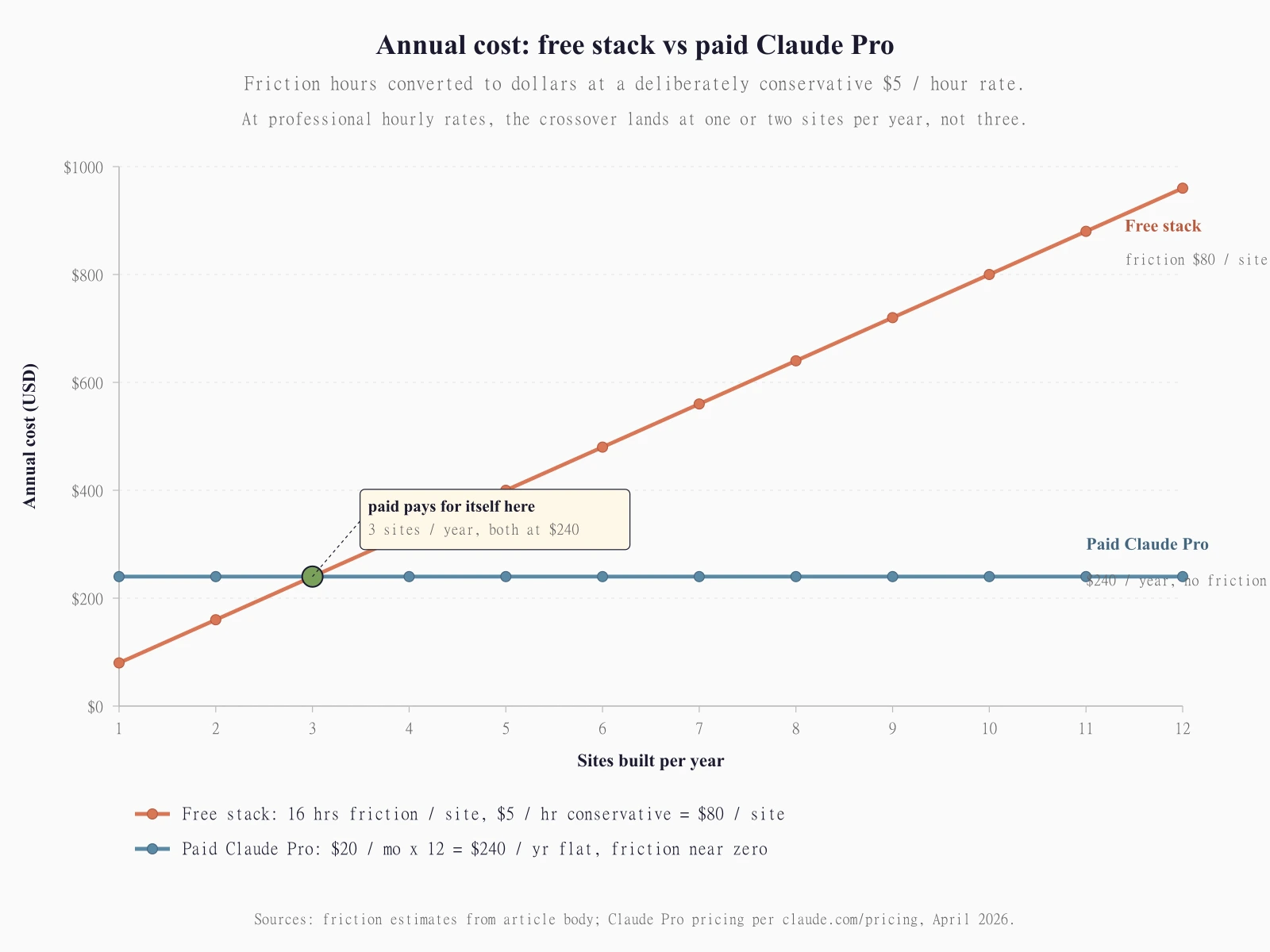
Sum of friction hours for an active builder on free, conservatively: 5 to 9 hours a week of active building, or roughly 14 to 20 hours over a typical two-week site build. At any hourly value north of $5, that is more expensive than $20 a month for anyone shipping more than three sites a year. At professional rates, the comparison is not close even on the first site. The chart below makes the trade-off visual.
Recommended combinations
Three combinations cover almost every real builder.
Zero-dollar stack, one-off small site. Claude Free for the HTML, Gemini Free in the consumer app for imagery, Cloudflare Pages or GitHub Pages free tier for hosting. Total cost zero. Time-to-ship one to three hours.
Solo-builder paid stack, three-plus sites a year. Claude Pro at $20 for the build loop plus Google AI Plus at $7.99 for imagery. Total $27.99 a month. Crossover with the free stack lands inside the first build for anyone whose time is worth more than $5 an hour.
Heavy use, real product. Claude Max 5x at $100 plus Google AI Pro at $19.99 for Nano Banana Pro and the 1M-token context window. Total $119.99 a month. The Max tier is the line where Claude Code stops feeling tight on Pro's roughly 44,000 tokens per five-hour period.
ChatGPT Plus at $20 fits as a second-opinion tool. It is rarely the right primary build surface for HTML-and-CSS website work, but Codex on Plus is a respectable backup when Claude Code is in a downstate or hitting cap. The frontier-model trade-offs that decide which of Claude, GPT-5.4, or Gemini to lean on for any specific task are mapped in the real ranking of top frontier AI models for April 2026.
When no AI is the right answer
A short list, and an honest one. If the build is one paragraph of HTML for a redirect page, write it. If a free Squarespace template will do, use it. If the entire site is a single landing page that already exists in Figma and just needs export, no model in this comparison adds value over a static export. AI is a force multiplier, not a tax.
Frequently asked questions
Is Claude Code still bundled with Claude Pro at $20 in April 2026?
Yes, on the canonical claude.com/pricing page as of late April 2026, Pro lists "Includes Claude Code" alongside Claude Cowork and unlimited projects. On April 21, 2026 Anthropic briefly removed the bundling for new prosumer signups; the change was reversed within hours after backlash. Head of growth Amol Avasare confirmed a 2 percent test on new signups continues, but existing Pro and Max subscribers were never affected. Budget Pro at $20 as the price of Claude Code for now, with a chance the bundling shifts in a future tier reshuffle.
Does Gemini Advanced still exist as a paid plan?
The branding has changed. The paid Gemini consumer plans are now Google AI Plus ($7.99 a month), Google AI Pro ($19.99), and Google AI Ultra ($249.99). The "Gemini Advanced" page at gemini.google.com/advanced still exists as a header on legacy URLs, but the actual product line is the AI Plus / Pro / Ultra trio.
How many images per day do I get on free Gemini versus free ChatGPT?
Free Gemini in the consumer app ships 20 Nano Banana 2 image generations per day. Free ChatGPT ships 2 to 3 GPT Image 1.5 generations per day on a 24-hour rolling window. For website imagery, free Gemini wins this comparison on volume by roughly an order of magnitude.
At what point does a paid AI subscription pay for itself for a builder?
The friction-time model in the chart above puts the crossover at three to four websites built, assuming a deliberately conservative $5 an hour value of time. At any professional rate the paid plan recovers its cost inside the first project. The deciding variables are how often you build, how complex each build is, and how much your hourly time is worth.
Do I need ChatGPT Plus if I already pay for Claude Pro?
Almost never for website-building work. Plus is useful as a second-opinion tool, an alternate copy voice, or for Codex when Claude Code is in a downstate. It is rarely the cleaner primary build surface for HTML, CSS, and JavaScript. The two strongest reasons to add Plus on top of Claude Pro are GPT-5.4 Thinking access and full-strength image generation at 200 a day, neither of which a typical builder needs.
Is the free-only stack actually deployable to a real domain?
Yes. Claude Free renders the HTML, Gemini Free generates the imagery, Cloudflare Pages or GitHub Pages hosts on a real subdomain (yoursite.pages.dev, yoursite.github.io) on the free tier. A custom domain costs $8 to $15 a year and is the only paid step in the entire pipeline. The full free deployment workflow is documented in the portfolio website with free AI models guide.
How does the new $100 ChatGPT Pro tier compare to Claude Max at $100?
The two products at the same price are not equivalent. ChatGPT Pro at $100 (added April 9, 2026) gives 5x Plus usage caps across all models, GPT-5.4 Pro access, o1 Pro mode, and higher Codex quotas. Claude Max 5x at $100 gives 5x Pro usage with Sonnet 4.6 and Opus 4.6 plus Claude Code with priority access. For website-building specifically, Max 5x is the stronger pick because Claude Code's terminal-first agent loop is genuinely ahead of Codex for multi-file refactors. For broader workflows that lean on image generation, voice, or Sora, the $100 ChatGPT tier looks better. Claude Code defining the coding-agent category, in Simon Willison's framing, is the reason most builders pick the Anthropic side of this trade.